Lloyds Pharmacy offers accessible tools for home health monitoring, including blood pressure monitors with readily available user manuals and guides in PDF format.
These devices, like the BM52 and KD-525, empower individuals to track their cardiovascular health conveniently, often featuring voice guidance and data recording.
Understanding the oscillometric measurement method and proper usage, detailed in provided instructions, is key for accurate readings and effective hypertension management.
What is a Blood Pressure Monitor and Why Use One?
Blood pressure monitors, like those from Lloyds Pharmacy, are vital tools for regularly assessing your cardiovascular health at home. These devices measure the force of blood against artery walls, providing crucial data for managing hypertension.
Utilizing a monitor, guided by the user manual, allows proactive tracking, early detection of irregularities, and informed discussions with healthcare professionals.
Consistent monitoring supports effective treatment adherence and empowers individuals to take control of their wellbeing, potentially preventing serious health complications.
Types of Lloyds Pharmacy Blood Pressure Monitors Available
Lloyds Pharmacy offers a range of blood pressure monitors to suit individual needs, including fully automatic models like the BM52, known for its speaking function and ease of use, as detailed in its user manual.
The KD-525 model is also available, requiring reference to its specific instructions for operation.
These monitors generally employ oscillometric measurement, and some offer connectivity to smartphone applications for data tracking and analysis.
Understanding Your Lloyds Pharmacy Blood Pressure Monitor
Lloyds Pharmacy monitors utilize an oscillometric method for measurement, as explained in the user manual, and feature key components for accurate blood pressure readings;
Familiarize yourself with display symbols for proper interpretation.
Key Components and Their Functions
Lloyds Pharmacy blood pressure monitors consist of several vital parts. The cuff, essential for encircling your arm, measures pressure changes. The monitor itself houses the inflation pump and measurement system.
Power is supplied by batteries (typically four 1.5V AA size), and the display clearly shows readings. Some models offer memory storage for tracking data over time.
The start/stop button initiates measurements, while other buttons manage memory functions or settings, as detailed in the user manual.
Display Symbols and Indicators
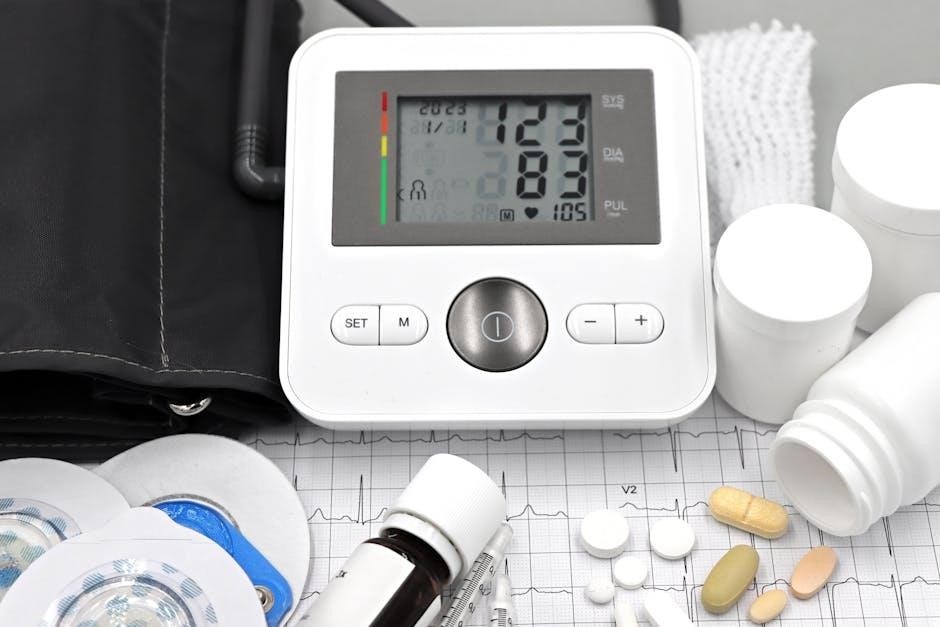
Lloyds Pharmacy monitor displays utilize symbols for clear communication. A heart rate symbol indicates pulse rate, while “SYS” and “DIA” represent systolic and diastolic pressure, respectively.
Battery indicators signal low power, prompting replacement. Error messages, detailed in the user manual, alert users to issues like cuff errors or movement during measurement.
Memory symbols show data storage status, and some models display average readings or irregular heartbeat detection symbols for comprehensive health insights.
Preparing for a Blood Pressure Measurement
Before use, consult the Lloyds Pharmacy user manual for proper technique. Ensure a calm environment, correct posture, and appropriate cuff application for accurate results.
Avoid caffeine, exercise, and smoking for at least 30 minutes prior to measurement.
Correct Positioning and Posture
Lloyds Pharmacy manuals emphasize sitting comfortably with your back supported and feet flat on the floor – avoid crossing your legs.
Your arm should be supported at heart level, relaxed, and with the palm facing upwards.
Ensure a quiet environment to minimize stress, as anxiety can elevate readings.
Maintain this posture throughout the measurement process for reliable results, as detailed in the instructions.
Incorrect positioning significantly impacts accuracy.
Applying the Cuff Correctly
Lloyds Pharmacy manuals instruct to apply the cuff snugly to your upper arm, approximately 2-3cm above the elbow.
The artery marker on the cuff should align with your brachial artery.
Avoid applying the cuff over clothing; bare skin is essential for accurate measurements.
Ensure the cuff isn’t too tight or too loose – comfortable snugness is key, as detailed in the instructions.
Incorrect cuff application leads to inaccurate blood pressure readings.
Avoiding Factors That Can Affect Readings
Lloyds Pharmacy manuals emphasize avoiding caffeine, alcohol, and smoking for at least 30 minutes before measurement.
Empty your bladder beforehand, as a full bladder can elevate readings.
Rest for five minutes in a quiet room before taking measurements, ensuring a relaxed state.
Avoid talking or moving during the reading process, as outlined in the instructions.
Emotional stress and recent exercise can also distort results; maintain calmness and stillness.

Taking a Blood Pressure Measurement
Lloyds Pharmacy manuals detail step-by-step operation for both automatic and manual monitors, ensuring accurate readings.
Follow the instructions carefully, applying the cuff correctly and remaining still during inflation and measurement.
Step-by-Step Guide to Operation (Automatic Monitors)
To begin, ensure the cuff is correctly applied, following Lloyds Pharmacy manual instructions for proper positioning. Press the ‘Start’ button; the monitor will automatically inflate the cuff.
Remain still and quiet during inflation and deflation. The monitor displays systolic, diastolic pressure, and pulse rate. Record these values for tracking. Refer to the manual for interpreting readings.
Ensure the monitor is powered on and the cuff is connected securely. Avoid movement or talking during measurement for accurate results. Review the user guide for specific model details.
Step-by-Step Guide to Operation (Manual Monitors)
First, correctly apply the cuff and position the bulb securely. Close the valve on the bulb by turning the screw clockwise. Pump the bulb rapidly until the display reads approximately 30 mmHg above your usual systolic pressure.
Slowly release the valve, deflating the cuff at a rate of 2-3 mmHg per second. Listen carefully for Korotkoff sounds using a stethoscope. Note the reading when the first sound appears (systolic) and disappears (diastolic).
Consult the Lloyds Pharmacy manual for detailed illustrations and safety precautions. Practice is essential for accurate manual readings; seek guidance if needed.
Interpreting Your Blood Pressure Readings
Understand systolic (top number) and diastolic (bottom number) pressures. Refer to the Lloyds Pharmacy manual for blood pressure categories and their health implications.
Consult a healthcare professional for personalized interpretation and guidance based on your readings.
Understanding Systolic and Diastolic Pressure
Systolic pressure, the higher number, represents the force your heart exerts when beating, pushing blood through arteries. Diastolic pressure, the lower number, measures the pressure in arteries when your heart rests between beats.
Lloyds Pharmacy monitors display both values, crucial for a complete assessment. Refer to your device’s manual for detailed explanations and normal ranges. Understanding these measurements, alongside guidance from a healthcare professional, is vital for managing cardiovascular health effectively.
Blood Pressure Categories and What They Mean
Lloyds Pharmacy monitors help track readings falling into categories like Normal, Elevated, Stage 1 Hypertension, and Stage 2 Hypertension, as defined by health guidelines. Consult your manual for specific numerical ranges associated with each category.
Understanding these classifications is crucial, but self-diagnosis is discouraged. Always discuss your readings with a healthcare professional for accurate interpretation and personalized advice regarding your cardiovascular health and potential treatment options.
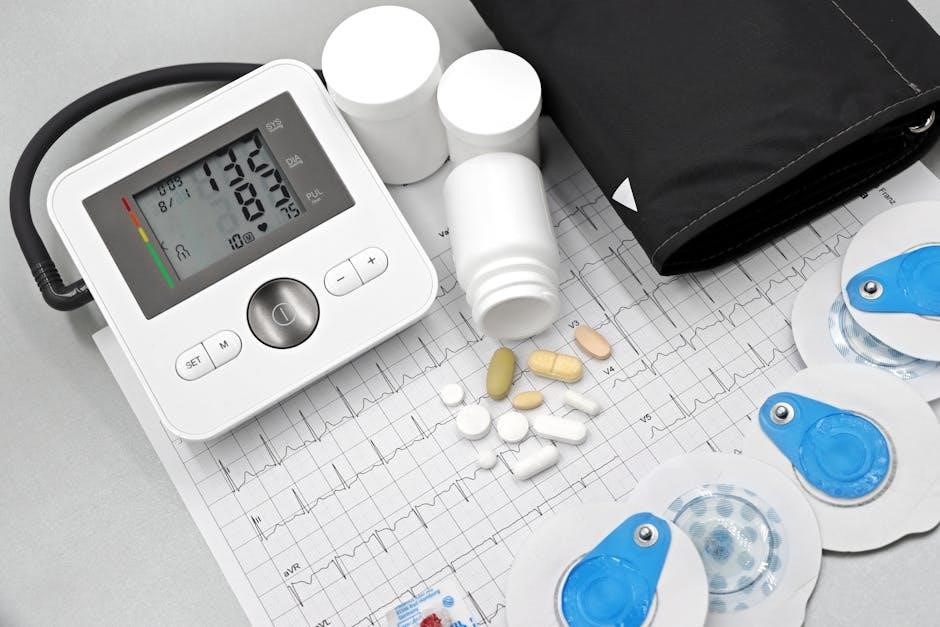
Memory Function and Data Recording
Lloyds Pharmacy monitors often store readings for tracking trends; user manuals detail how to access and utilize this memory function for review.
Some models allow data download for comprehensive analysis and sharing with healthcare providers, enhancing personalized care.
How to Store Readings on Your Monitor
Lloyds Pharmacy blood pressure monitors typically feature an internal memory to automatically store your readings for future reference. Consult your specific user manual, as procedures vary by model.
Generally, after a successful measurement, the reading is saved automatically. The monitor may display a memory indicator. To access stored data, press the ‘Memory’ or ‘Recall’ button, as outlined in the manual.
You can then cycle through previously recorded systolic, diastolic, and pulse values, allowing you to monitor changes over time and share information with your doctor.
Downloading and Reviewing Data (If Applicable)
Some advanced Lloyds Pharmacy blood pressure monitors offer connectivity to smartphone applications for enhanced data management. Check your user manual to determine if your model supports this feature.
If applicable, download the compatible app (potentially Withings) and follow the pairing instructions. Once connected, data can be automatically synchronized, allowing for detailed tracking and graphical representation of your blood pressure trends.
This facilitates easier review and sharing of information with healthcare professionals.
Troubleshooting Common Issues
Lloyds Pharmacy monitor issues, like error messages or a monitor failing to power on, are addressed in the user manual.
Solutions for inaccurate readings and specific KD-525 problems are also detailed for effective troubleshooting.
Error Messages and Their Solutions
Lloyds Pharmacy blood pressure monitor error messages indicate potential problems requiring attention; consult your user manual for specific codes.
Common errors might relate to cuff pressure, movement during measurement, or low battery power. The manual provides step-by-step solutions, such as re-applying the cuff correctly, remaining still, or replacing the batteries.
If an error persists, referencing the manual’s troubleshooting section or contacting Lloyds Pharmacy customer service is recommended for further assistance and accurate diagnosis.
Monitor Not Turning On
If your Lloyds Pharmacy blood pressure monitor fails to power on, first check the batteries, ensuring correct polarity and sufficient charge – typically four 1.5V AA batteries.
Consult the user manual for battery installation instructions. A low battery indicator may appear before complete failure. If new batteries don’t resolve the issue, inspect the battery compartment for corrosion or damage.
Contacting Lloyds Pharmacy support may be necessary if the problem persists, indicating a potential device malfunction.
Inaccurate Readings
Lloyds Pharmacy monitor inaccuracies often stem from improper cuff application or patient movement during measurement; refer to the user manual for correct positioning.
Ensure the correct cuff size is used, and avoid factors like caffeine, smoking, or exercise before testing. Repeated measurements, averaging readings, and verifying the device against a calibrated monitor can help.
If inconsistencies persist, consult your healthcare provider and review the troubleshooting section within the manual.
Battery Information and Replacement
Lloyds Pharmacy monitors typically require four 1.5V AA batteries; the user manual details installation and includes a low battery indicator for timely replacement.
Ensure correct polarity when inserting new batteries to maintain accurate functionality and reliable blood pressure readings.
Battery Type and Installation
Lloyds Pharmacy blood pressure monitors generally utilize four AAA alkaline (LR3) batteries as their power source, often included with the initial purchase. Refer to your specific model’s user manual for confirmation.
To install, locate the battery compartment, usually on the back or side of the device. Insert the batteries, strictly adhering to the polarity markings (+ and -) indicated inside the compartment. Incorrect installation will prevent operation.
Always replace all batteries simultaneously with new ones of the same type; do not mix old and new batteries.
Low Battery Indicator
Lloyds Pharmacy blood pressure monitors feature a low battery indicator to alert you when battery replacement is needed, ensuring continuous and accurate measurements. This indicator typically appears as a battery symbol on the display screen.
When the indicator illuminates, replace all batteries immediately to avoid measurement errors or device malfunction. Do not wait for the monitor to completely lose power before changing the batteries, as this could affect reading reliability.
Consult your user manual for specific indicator details.
Cleaning and Maintenance
Lloyds Pharmacy monitors require gentle cleaning with a soft, dry cloth; avoid liquids. Proper storage, away from extreme temperatures and humidity, ensures longevity and accuracy.
Regularly check the cuff for damage, as outlined in the user manual.
Proper Cleaning Procedures
To maintain hygiene and accuracy, gently wipe the main unit and cuff with a soft, dry cloth. Avoid using water, solvents, or abrasive cleaners, as these can damage the device. Ensure the monitor is switched off and disconnected from any power source before cleaning.
For stubborn marks, lightly dampen the cloth – do not saturate it. Never immerse the monitor or cuff in water. Regular cleaning, as detailed in the user manual, prolongs the lifespan and ensures reliable readings.
Storage Guidelines
To ensure longevity, store your Lloyds Pharmacy blood pressure monitor in a cool, dry place, away from direct sunlight and extreme temperatures. Avoid storing the device with the cuff tightly wrapped, as this can damage the tubing. Keep it in its original case, if available, for protection.
Remove batteries for prolonged storage to prevent leakage and corrosion, referencing the user manual for specific battery instructions. Proper storage maintains accuracy and extends the monitor’s functional life.

Safety Precautions
Consult a healthcare professional before self-monitoring, especially with pre-existing conditions. Follow manual instructions carefully; misuse can lead to inaccurate readings. Do not use on infants.
Contraindications and Warnings
Lloyds Pharmacy blood pressure monitors are not intended for diagnosis or treatment. Individuals with certain conditions, such as arrhythmias or arterial sclerosis, should consult their doctor before use.
Avoid using the monitor on limbs with IV lines, medical devices, or skin irritation. Do not disassemble or modify the device. Ensure the cuff isn’t applied over clothing, as this impacts accuracy.
Caution: Repeated measurements can cause temporary discomfort. If pain persists, discontinue use and seek medical advice. Always follow the manual’s guidance for safe operation.
Important Safety Information
Lloyds Pharmacy monitors are designed for non-professional use; always consult a healthcare provider for interpretation of results. Keep the device dry and away from extreme temperatures.
Never allow children to use the monitor unsupervised. Regularly check for cuff damage and replace if necessary. Ensure batteries are installed correctly, following the manual’s polarity guidelines.
Do not attempt to repair the monitor yourself; contact customer service for assistance. Proper storage and handling, as outlined in the guide, are crucial for longevity.
Frequently Asked Questions (FAQ)
Common questions address monitor operation, error messages, and data synchronization with mobile apps, all detailed within the user manual.
Users frequently inquire about cuff placement, battery replacement, and troubleshooting inaccurate readings, finding solutions in provided guides.
Common Questions About Lloyds Pharmacy Monitors
Frequently asked questions center around proper cuff application, ensuring accurate readings, and understanding displayed symbols as outlined in the user manual.
Many users inquire about connecting their Lloyds Pharmacy monitor to smartphone applications for data tracking and synchronization, seeking guidance on the process.
Troubleshooting common issues like error messages, monitor malfunctions, and inaccurate results are also prevalent, with solutions detailed in the provided documentation.
Battery installation and replacement procedures, alongside understanding low battery indicators, are common points of clarification for new users.
Addressing User Concerns
User concerns frequently involve difficulties downloading and reviewing recorded data, particularly when attempting to utilize mobile app connectivity as described in the manual.
Some users report challenges with the oscillometric measurement method, questioning its accuracy and seeking clarification on potential limitations.
Issues with the KD-525 model often necessitate specific troubleshooting steps, detailed within its dedicated section of the comprehensive user guide.
Clarification regarding contraindications, warnings, and proper safety precautions is also commonly requested, emphasizing the importance of careful review.
Where to Find Additional Support
Lloyds Pharmacy customer service provides direct assistance, while online resources offer downloadable manuals and FAQs for their blood pressure monitors.
Fixya and YouTube tutorials also offer solutions to common issues and guidance on using specific models like the KD-525.
Lloyds Pharmacy Customer Service Contact Information
Lloyds Pharmacy provides customer support for their blood pressure monitors, though specific contact details aren’t readily available online within the provided snippets.
However, users experiencing issues can often find assistance through the manuals themselves, or by visiting a local Lloyds Pharmacy store for in-person guidance.
Fixya’s forum also serves as a community resource where users share solutions and seek help regarding specific models like the KD-525, supplementing official support channels.
Checking the packaging or the Lloyds Pharmacy website is recommended for the most up-to-date contact information.
Online Resources and Manual Downloads
Lloyds Pharmacy offers blood pressure monitor manuals and user guides in PDF format for download, accessible for various devices, including the KD-525 model.
These resources provide detailed instructions on operation, troubleshooting, and understanding readings, aiding users in effective home monitoring.
Websites like Fixya host user-submitted questions and solutions, offering supplementary support and insights.
A general “Buyers Guide Blood Pressure Monitors” PDF is also available online, providing broader information on the topic.
Model-Specific Instructions (KD-525)
Lloyds Pharmacy KD-525 monitors require careful attention to the manual for unique features and specific troubleshooting steps, ensuring accurate blood pressure readings.
Refer to the provided documentation for optimal performance.
Unique Features of the KD-525 Model
The Lloyds Pharmacy KD-525 boasts a fully automatic measurement system, simplifying blood pressure monitoring at home. This model utilizes the oscillometric method, providing reliable readings with manual inflation.
It requires four 1.5V AA batteries for power and features a cuff pressure range of 0-300 mmHg. The KD-525 is designed for ease of use, offering a straightforward operation for individuals seeking convenient health tracking.
Always consult the user manual for detailed instructions and safety precautions.
Specific Troubleshooting for KD-525
If your KD-525 fails to power on, ensure fresh batteries are correctly installed. For error messages, consult the user manual for specific codes and solutions. Inaccurate readings may stem from improper cuff placement or movement during measurement.
Verify the cuff size is appropriate and avoid factors like caffeine or exercise before testing. If issues persist, contact Lloyds Pharmacy customer service for assistance, referencing the model number KD-525.

Understanding Oscillometric Measurement Method
Lloyds Pharmacy monitors utilize the oscillometric method, detecting blood pressure by measuring oscillations created as blood flows through arteries, offering a convenient, non-invasive approach.
While accurate, limitations exist; movement or improper cuff fit can affect readings, emphasizing the importance of following manual guidelines.
How Oscillometric Monitors Work
Oscillometric monitors, like those from Lloyds Pharmacy, inflate a cuff to temporarily restrict blood flow. As the cuff deflates, the monitor detects oscillations – subtle pressure changes – within the artery.
These oscillations are analyzed by an algorithm to determine systolic (highest pressure) and diastolic (lowest pressure) values. This method avoids auscultation (listening with a stethoscope) and provides automated, user-friendly readings.
The user manual details proper cuff placement, crucial for accurate oscillation detection and reliable blood pressure measurements.
Accuracy and Limitations of the Method
While oscillometric methods are convenient, the Lloyds Pharmacy user manual emphasizes potential limitations. Accuracy can be affected by irregular heartbeats, movement during measurement, or improper cuff size/placement.
These monitors may slightly underestimate blood pressure in some individuals. Consistent technique, following manual guidelines, minimizes errors.
It’s crucial to compare readings with a healthcare professional’s measurements for validation and to address any discrepancies.
Using the Monitor with Mobile Apps
Some Lloyds Pharmacy monitors connect to smartphone applications via Bluetooth for data synchronization and tracking, enhancing long-term health monitoring.
Refer to the user manual for compatibility and setup instructions, ensuring your device meets the iOS version requirements.
Connecting to Smartphone Applications
Lloyds Pharmacy blood pressure monitors, such as those from Withings, often facilitate seamless data transfer to smartphone applications. Begin by downloading the compatible app, ensuring your mobile device’s operating system (iOS 3 or higher) meets the requirements.
Enable Bluetooth on your smartphone and follow the in-app pairing instructions, typically involving a search for available devices. The user manual provides specific guidance for your model, detailing the connection process and troubleshooting steps if pairing fails.
Successful connection allows for automatic data synchronization, providing a convenient platform for tracking trends and sharing information with healthcare professionals.
Data Synchronization and Tracking
Once connected via Bluetooth, your Lloyds Pharmacy blood pressure monitor automatically synchronizes readings to the paired smartphone application. This process creates a detailed history of your blood pressure measurements, presented in easily understandable graphs and charts.
The app allows for long-term tracking, identifying trends and potential anomalies. User manuals detail how to review historical data, export reports, and potentially share information with your physician for informed healthcare decisions.
Consistent data tracking empowers proactive health management;